
The Elephant in the Room: Navigating Safety as a Host and a Traveling Nomad
The beauty of the work exchange movement—facilitated by platforms like Workaway, WWOOF, and HelpX—lies in its radical reliance on human trust. It operates on the beautiful, somewhat rebellious premise that strangers are just friends you haven’t shared a meal with yet. It allows a software developer from Chicago to help build an eco-dome in Patagonia, and lets a retired couple in rural France breathe new life into their farm by hosting energetic backpackers.
But underneath the glowing reviews, the Instagram-worthy sunsets, and the romanticized idea of borderless living, there is an elephant in the room that we need to talk about: Safety.
Inviting a complete stranger into your home to live and work alongside your family is a massive leap of faith. Conversely, flying across the globe to live on a remote farm with people you’ve only spoken to through a screen is equally daunting. When the system works, it is life-changing. But when boundaries blur, communication breaks down, or malicious intent is present, the situation can quickly become uncomfortable, or even dangerous.
Safety is not just about avoiding worst-case scenarios; it is about creating an environment of mutual respect, clear boundaries, and psychological comfort. Whether you are the host opening your doors or the nomad packing your bags, safety is a shared responsibility. Here is how to protect your physical space, your mental well-being, and your overall experience.
The Foundation of Trust: Vetting on Platforms
Safety does not begin when the nomad walks through the front door; it begins the moment a message is sent. The platforms that facilitate these exchanges are not foolproof background check agencies, meaning the responsibility of vetting falls squarely on the users.
Reading Between the Lines of Reviews
Reviews are the currency of the sharing economy. However, because both hosts and nomads fear retaliatory bad reviews, people are often overly polite, even when an experience was subpar. You have to learn to read between the lines.
For Nomads: If a host has 20 reviews and they all just say, “Nice place, worked hard,” without mentioning the host’s personality, warmth, or the cultural exchange, that is a subtle red flag. It often indicates a transactional environment where the host treats volunteers purely as free labor. Look for reviews that mention shared meals, deep conversations, and the host going out of their way to make the volunteer feel safe.
For Hosts: Look at the length and detail of the reviews left by the nomad for previous hosts. A traveler who takes the time to write a thoughtful, detailed review is likely conscientious and respectful. If a nomad has no reviews, they aren’t necessarily a bad risk, but they require a much deeper interview process.
The Non-Negotiable Video Call
Never finalize an arrangement via text alone. A video call is the single most important safety filter for both parties.
During a video call, you are checking for “vibe” and communication style. Does the host seem disorganized or overly demanding? Does the volunteer seem entitled or dismissive of your house rules?
Nomads: Ask the host to walk you around the property with their phone. Ask to see the exact room/bed you will be sleeping in. If they hesitate or the living conditions look drastically different than the polished profile photos, trust your gut and walk away.
Hosts: Use this time to clearly state your dealbreakers (e.g., “We are a strictly sober household,” or “We need someone who can work independently for 4 hours a day”). Gauge their reaction. If they seem hesitant or try to immediately negotiate your boundaries, they are not a good fit.
Safety for the Traveling Nomad: Before You Arrive
As a traveler, you are inherently the more vulnerable party. You are entering a foreign environment, often in a remote area where you do not speak the local language or understand the local transportation system. Preparation is your best defense.
1. The “Exit Strategy” Fund
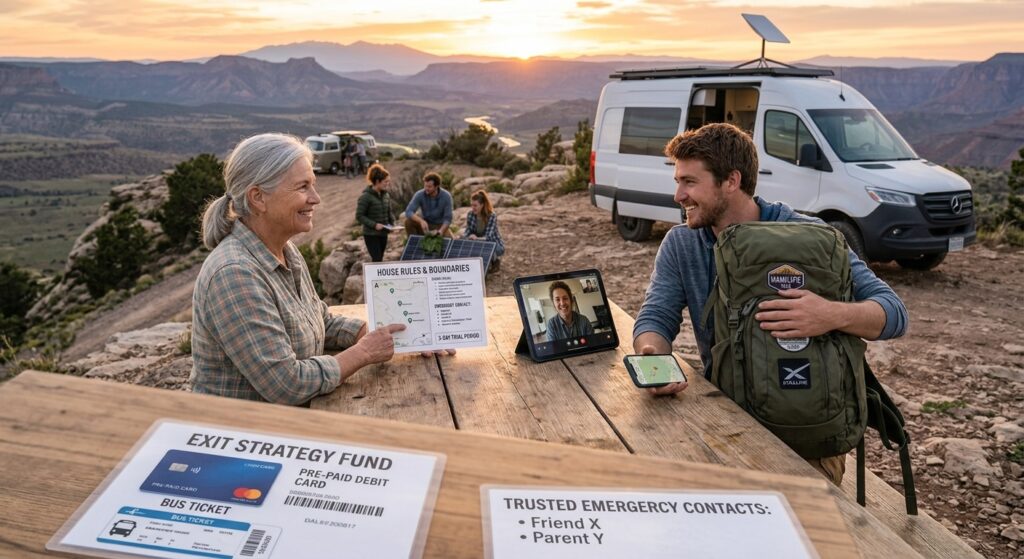
The most critical safety tool a nomad can have is not pepper spray or a whistle; it is an Emergency Exit Fund. Never travel to a work exchange with zero dollars in your bank account. You must always have enough accessible funds to pay for an immediate taxi ride to the nearest town, two nights in a hotel, and a bus/plane ticket out. If you arrive at a farm and the host is entirely different from their online persona, or if you feel physically unsafe, you cannot be financially trapped. Financial independence equals freedom of movement.
2. Share Your Itinerary
Before you lose Wi-Fi on a rural bus route, send your exact itinerary to at least two trusted friends or family members. Provide them with:
* The host’s full name, profile link, and phone number.
* The exact address or GPS coordinates of the property.
* Your expected arrival time.
* A pre-arranged “check-in” time (e.g., “I will text you by 8 PM tonight. If you don’t hear from me by 10 AM tomorrow, try calling the host. If they don’t answer, contact the platform/local authorities.”)
3. Know the Local Infrastructure
Do not rely entirely on your host for transportation. Before you arrive, research the local area. How far is the nearest town? Is there a local bus route? Does Uber or a local equivalent operate there? If things go south and the host refuses to drive you to the station, you need to know how to walk or navigate your way to public infrastructure.
Safety for the Host: Protecting Your Sanctuary
For hosts, the anxiety often centers around the invasion of privacy, property damage, or inviting an unstable personality into a family dynamic. Your home is your sanctuary, and you have every right to protect it fiercely.
1. The Power of the “Trial Period”
One of the most effective ways to manage risk is to explicitly agree on a probationary period before the nomad arrives. In your initial communication, state: “We are so excited to host you for three weeks. However, we always do a 3-day trial period for all our volunteers. This gives both of us a chance to see if we are a good fit. If after 3 days either of us feels it isn’t working out, there will be no hard feelings, and we will help you find transportation to the nearest hostel.” This creates a psychological “out.” If the volunteer arrives and they are deeply disrespectful, lazy, or make you uncomfortable, you do not have to endure three weeks of misery. You invoke the 3-day rule and part ways professionally.
2. Securing Valuables and Setting Physical Boundaries
Trust is wonderful, but practicality is better. Before a volunteer arrives, remove high-value items, sensitive financial documents, and sentimental heirlooms from communal spaces. More importantly, establish clear physical boundaries on day one. Walk them through the house and explicitly state which areas are communal and which are strictly private. (e.g., “The kitchen and living room are yours to use anytime, but the hallway past the stairs and our master bedroom are strictly off-limits.”)
3. The “Eviction” Strategy
What happens if a volunteer refuses to work, becomes verbally aggressive, or breaks a major house rule? Hosts must be prepared to have the difficult conversation. Do not let resentment build. Address issues immediately, in public spaces if possible. If you need someone to leave, be firm, clear, and non-negotiable. “This arrangement is no longer working for us. We need you to pack your things. We will drive you to the bus station at noon.” Do not get drawn into arguments or negotiations. If a volunteer refuses to leave your property, you have the right to contact local authorities to have them removed for trespassing.