
The Great Untethering: The American Digital Nomad Phenomenon and the Road to 2030
If you picture a “digital nomad,” your mind might instinctively conjure up an image of a budget backpacker typing away on a sandy beach in Bali, or a twenty-something crammed into a dimly lit hostel struggling with a spotty Wi-Fi connection. For a long time, that stereotype held a degree of weight. But the modern remote workforce has aggressively evolved. Today, the digital nomad phenomenon in the United States has morphed into a sophisticated, mainstream movement fueled by high-earning professionals, forward-thinking corporate policies, and a fundamental reimagining of the American Dream.
What began as a niche subculture has ballooned into an undeniable economic and cultural force. The COVID-19 pandemic catalyzed this shift, forcefully breaking the traditional tethers that tied knowledge workers to physical office spaces. But while the pandemic may have sparked the remote work revolution, it is the enduring desire for autonomy, flexibility, and geographical arbitrage that has sustained it long after the lockdowns ended. We are no longer looking at a temporary trend; we are witnessing a permanent structural change in how Americans live and work.
As we look toward the year 2030, the trajectory of this movement reveals profound implications for urban planning, corporate structure, global tourism, and the very definition of a “home base.” The numbers behind digital nomadism have grown far too big to ignore. This deep dive explores the staggering growth of the traveling nomad phenomenon in the United States, unpacks the demographics of the modern location-independent worker, and projects the far-reaching outcomes of this lifestyle as we approach the end of the decade.
The Staggering Scale of the Movement
To understand where we are going, we must first look at the sheer numbers driving this phenomenon today. The growth of the digital nomad population in the United States did not happen in a straight line—it exploded, stabilized, and has now settled into a steady, undeniable climb.
According to the latest data from MBO Partners, a staggering 18.5 million American workers currently identify as digital nomads. To put that in perspective, that is roughly 12% of the entire U.S. workforce. The historical context is even more revealing. In 2019, before the world fundamentally changed, there were only 7.3 million American digital nomads. By 2021, that number had more than doubled to 15.5 million. While the explosive, triple-digit growth of the pandemic era has naturally cooled, the population has continued to grow steadily, rising by 2.2% from 2024 to 2025. This growth occurred despite a major corporate push for return-to-office (RTO) mandates across multiple industries, proving the resilience of the lifestyle.
The United States isn’t just participating in this global trend; it is dominating it. Americans currently make up approximately 44% to 47% of the global digital nomad population, which is conservatively estimated to be over 40 million worldwide (with some estimates pushing as high as 80 million). This dominance is largely due to the high concentration of remote-friendly tech and knowledge economy jobs based in the U.S., coupled with the strong purchasing power of the American dollar abroad.
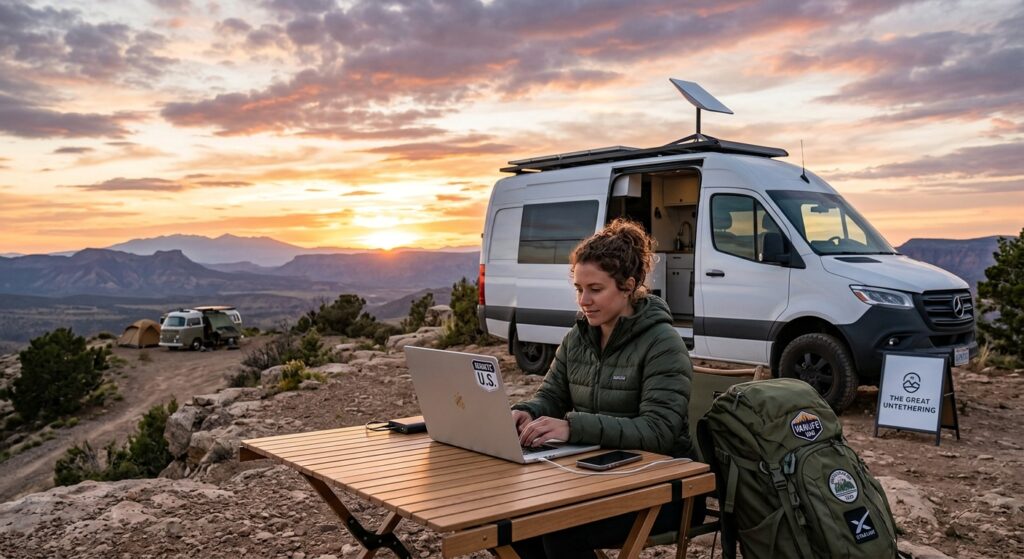
But the nomad lifestyle isn’t solely about border-hopping and passport stamps. Interestingly, a significant portion of American nomads are choosing to explore their own backyard. In recent years, data shows a distinct trend of “slowmadding” and domestic travel. Well over half of U.S. nomads plan to travel exclusively within the United States. This domestic focus has fueled a massive surge in “vanlife,” RV living, and long-term domestic Airbnb stays. It has turned rural towns, national parks, and mid-sized cities across the country into seasonal hubs for remote workers, shifting economic power away from traditional coastal megalopolises.
Who is the Modern American Nomad?
The stereotype of the unattached, entry-level freelancer avoiding commitment is officially dead. Today’s digital nomads are established professionals in their peak earning years. They are corporate employees, seasoned freelancers, and entrepreneurs who have simply chosen to disconnect their geographical location from their income stream.
Generational shifts are playing a massive role in this evolution. Currently, 75% of digital nomads belong to the two younger generations active in the workforce: Millennials (40%) and Generation Z (35%). Gen Z’s rise in this space has been nothing short of meteoric. In 2019, Gen Z made up less than 1% of the nomad population. As they have aged into the workforce—prioritizing flexibility, mental health, and life experiences over traditional corporate ladders—they have fundamentally altered the landscape. It is widely expected that Gen Z will officially surpass Millennials as the largest nomadic demographic within the next two to three years.
However, the phenomenon is not restricted to the youth. Almost one in nine U.S. digital nomads (11%) are 55 or older, proving that the desire for location independence spans across all age groups. Many older Americans are utilizing remote work to ease into retirement, exploring the country in RVs or spending extended periods abroad in lower-cost countries while maintaining part-time or consulting roles.
The demographic makeup is also becoming increasingly diverse. As of 2025, 27% of U.S. digital nomads are African American, a massive jump from just 13% in 2020. This surge is heavily attributed to the rapid expansion of the creator economy, which has provided new avenues for decentralized, independent income generation outside of traditional corporate structures.
Financially, this demographic wields immense power. The average digital nomad earns a highly competitive salary, with the majority falling between the $50,000 and $250,000 annual brackets. The average income reported across various studies sits around $124,000 a year. Over 91% of digital nomads hold a higher education degree. Crucially, roughly two-thirds of American digital nomads are traditional employees—meaning they hold full-time W-2 jobs rather than working as independent contractors. This highlights a monumental shift in corporate culture: companies are increasingly willing to allow their top talent to work from anywhere in order to retain them.
They are also remarkably happy. Studies consistently show that around 80% of digital nomads report being highly satisfied with their income and their work-life balance. The autonomy to control their own environment acts as a massive buffer against corporate burnout.
The Driving Forces and Technological Enablers
What is keeping this movement alive as the initial shockwaves of the pandemic fade into history? The answer lies in a convergence of advanced technology, shifting personal values, and basic economics.
First and foremost is the economic concept of geo-arbitrage. As the cost of living, housing, and healthcare in major American cities reaches unprecedented heights, knowledge workers are realizing that they can stretch their dollars exponentially further by leaving high-cost coastal hubs. Earning a San Francisco or New York salary while living in a mid-western town, the mountains of Montana, or even abroad in destinations like Thailand or Portugal, allows for a drastically elevated quality of life. For example, a modest $2,000-a-month apartment in New York City can be traded for a luxury setup in Bangkok or Hanoi for just $300 to $500 a month. With accommodation eating up roughly 44% of a typical nomad’s monthly budget, lowering housing costs instantly creates wealth.
Secondly, the technological infrastructure required to work from anywhere has reached a point of near-flawless reliability. High-speed internet is no longer tethered to a physical cable in a wall. The widespread rollout of 5G, the proliferation of eSIM technology for seamless global connectivity, and the advent of satellite internet solutions like Starlink have effectively erased the “dead zones” that used to plague digital nomads. Over 9,136 coworking spaces exist in the U.S. alone as of early 2026, providing professional ecosystems in almost every corner of the country.
Furthermore, artificial intelligence is supercharging the remote worker’s capabilities. A staggering 89% of digital nomads report using AI in their daily work, with the vast majority considering themselves intermediate or advanced users. This early adoption of cutting-edge technology allows them to automate routine tasks, increase productivity, and remain highly competitive in the global talent marketplace. They work across diverse industries, with Information Technology (21%), Creative Services (12%), and Education/Training (11%) leading the pack.